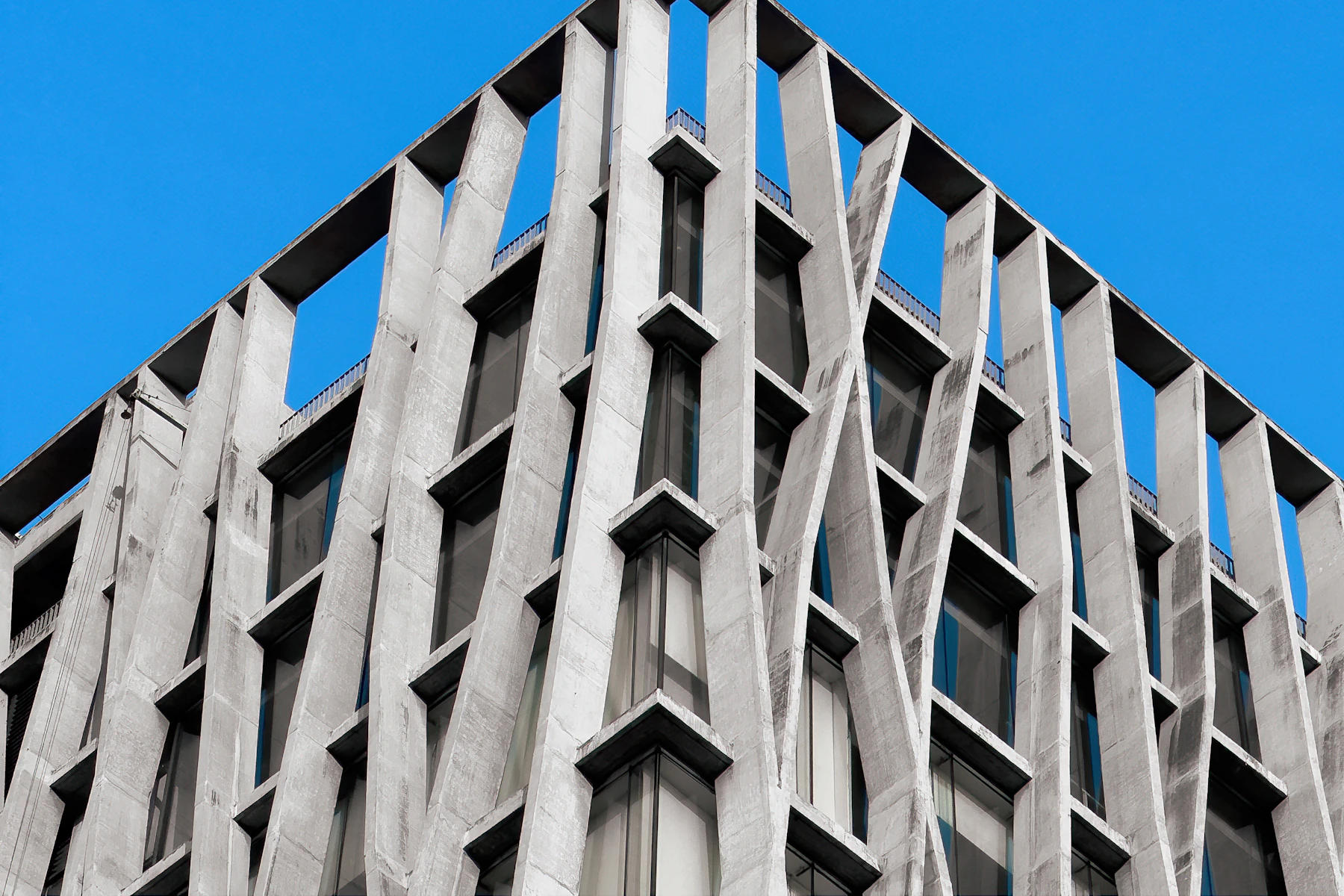
Some buildings are best understood by looking away from them.
Stand close to a wall, tip your head back, and the architecture becomes a frame. Concrete, glass, and shadow fall to the edges. What remains in the middle is an irregular piece of sky.
The frame changes the distance
An open sky usually feels immeasurable. A courtyard gives it a boundary, and the boundary makes distance visible. A narrow opening feels taller. A wide one brings the clouds closer.
The effect is physical before it is intellectual. Shoulders loosen. Sound changes. Attention moves from the street to the light above it.
Concrete makes blue brighter
Under direct sun, pale concrete holds a surprising range of color: cool grey, warm chalk, faint green reflected from trees. Against it, blue becomes almost excessive.
Photographs flatten this contrast, but they preserve the geometry. Repeated windows become a rhythm. A roofline becomes a horizon that can be tilted, cropped, and revisited.
Sometimes a place becomes memorable only after the obvious subject leaves the frame.
Looking up as a habit
Cities reward forward vision. Signs, crossings, doors, and other people keep the eyes near street level. Looking up interrupts that efficiency.
It is a small refusal to move only toward the next task. For a moment, the city is not a route. It is light, proportion, weather, and open space.